Evolving A Smile; Gaussian Splatting approaches
Ever since university, I've kept a passive interest in the world of computer graphics, and while learning about Gaussian-Splatting, a fairly new approach to novel-view synthesis, or generating 3 dimensional scenes from a series of image, I was struck by a similarity of the approach to one of my very old projects.
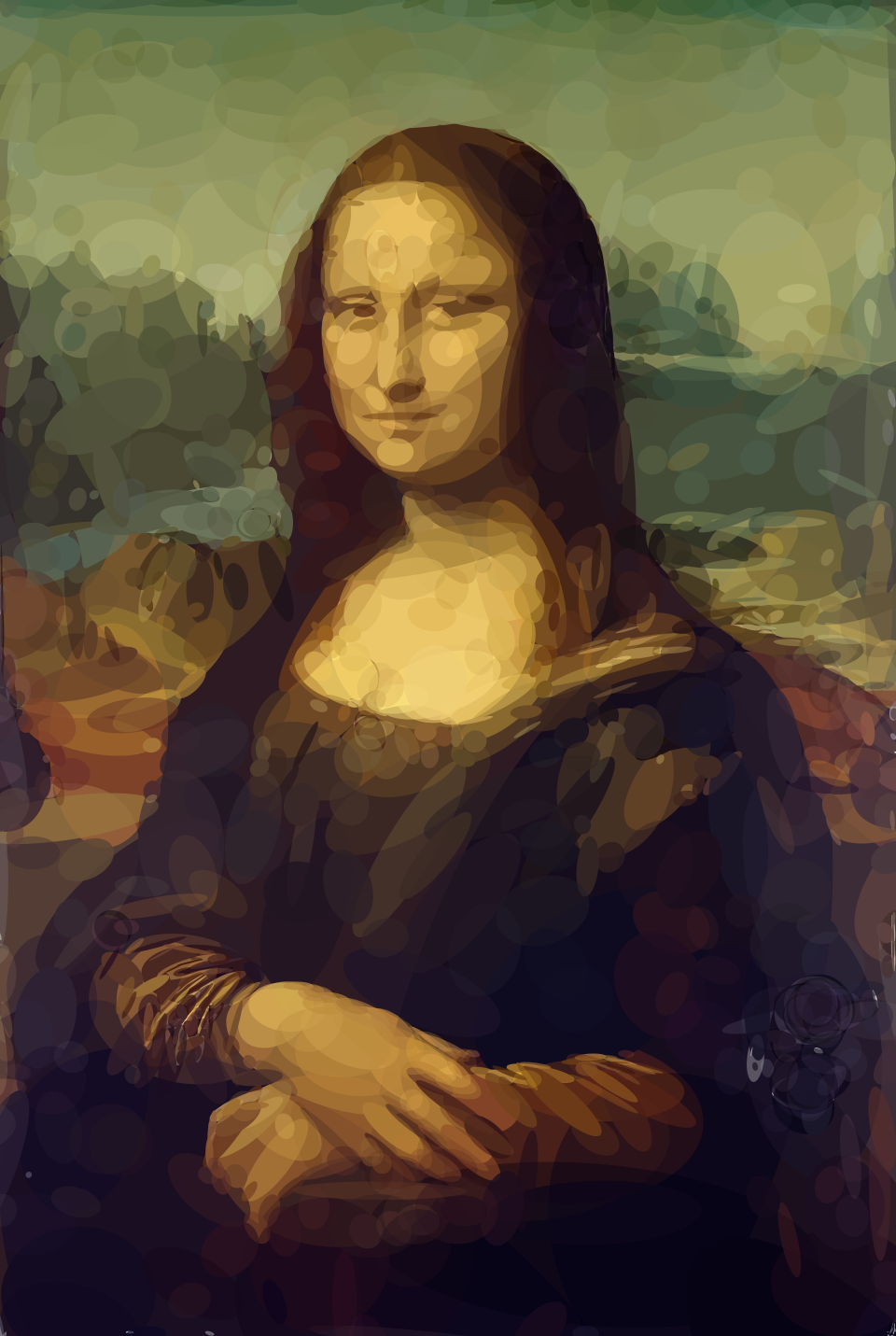
Almost 20 years ago, and inspired by a blog post by Roger Johansson, I played around with a genetic algorithm that generated an image to approximate the Mona Lisa based on overlapping translucent ellipses. If you squint hard enough at the problem, it's a little bit similar to gaussian splatting - in my version, an unguided gradient descent (using random mutations of a series of ellipses) found a local minima that minimized pixel difference of a target image.
Over the years, I'd used the project to experiment with some other techniques that piqued my interest, notably a collaborative approach that split the evolution across many connected browsers, allowing viewers to contribute to the overall result. I'd also used it to learn rust profiling.
Gaussian-Splatting is an interesting approach to novel-view synthesis that uses an "optimisation phase" akin to "training" the output image with a stochastic gradient descent - to me the parallel was clear. In Gaussian-Splatting, the gradient descent is an iterative approach that uses "adaptive density control" to add or remove the gaussian blobs from areas with high error. As I thought about it, I wondered what this approach would look like on my old problem.
In the old-days of more than a year ago, all of the code was handwritten. Nowadays, I could burn a few tokens and see in an evening.
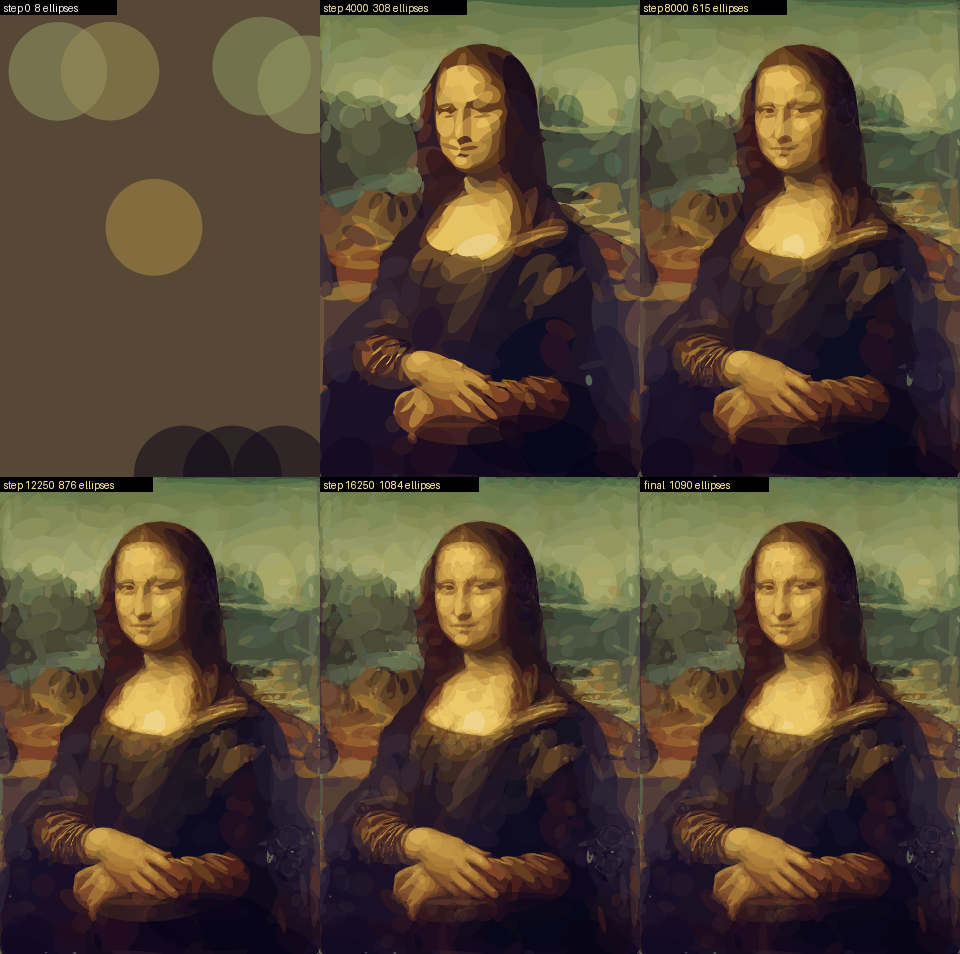
My new approach uses pytorch to drive the gradient descent, with a periodic density control step to add, split or remove ellipses. I also used a hyperparameter tuning step that used a variety of art from wikimedia to adjust fixed constants in the code.
As a compression technique
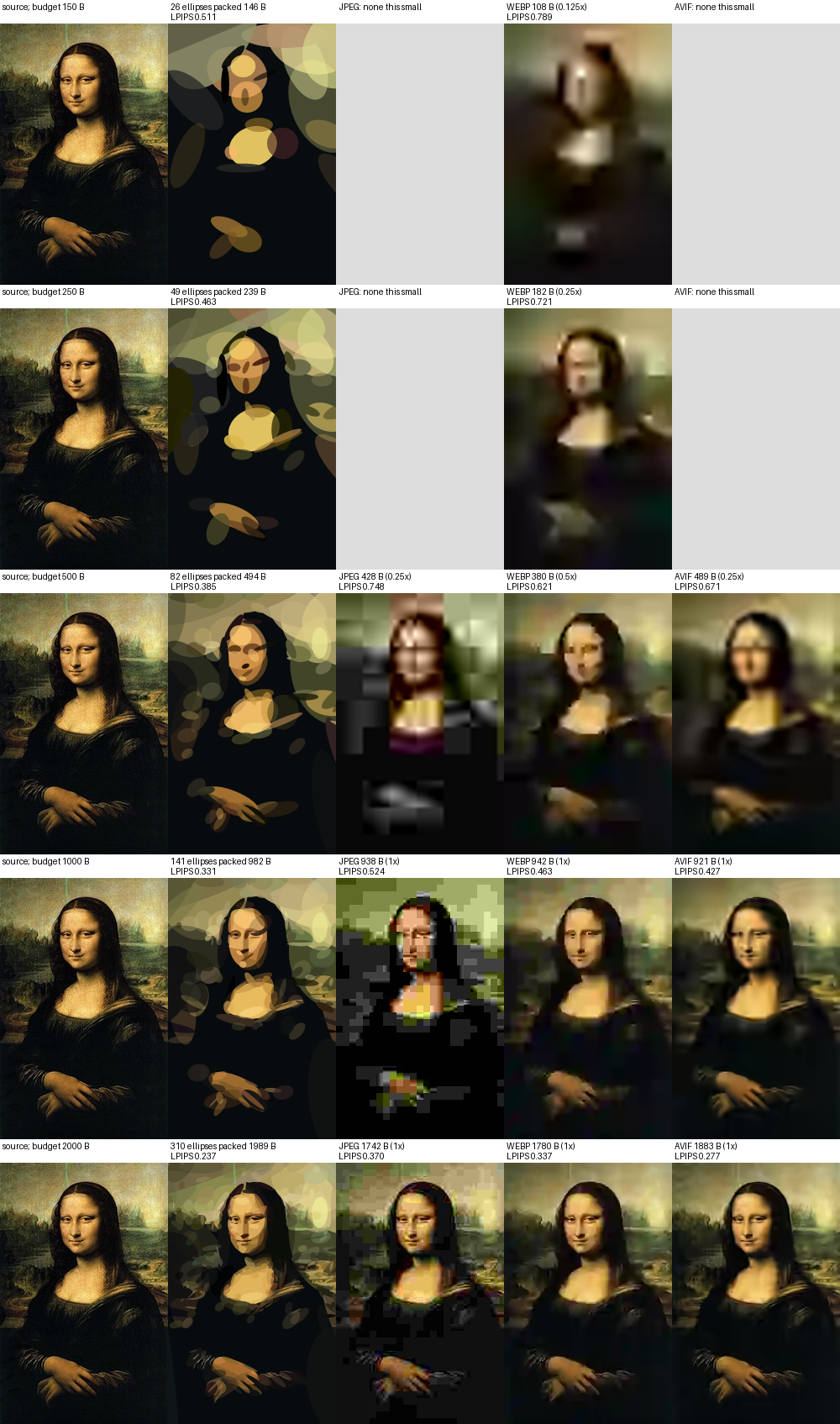
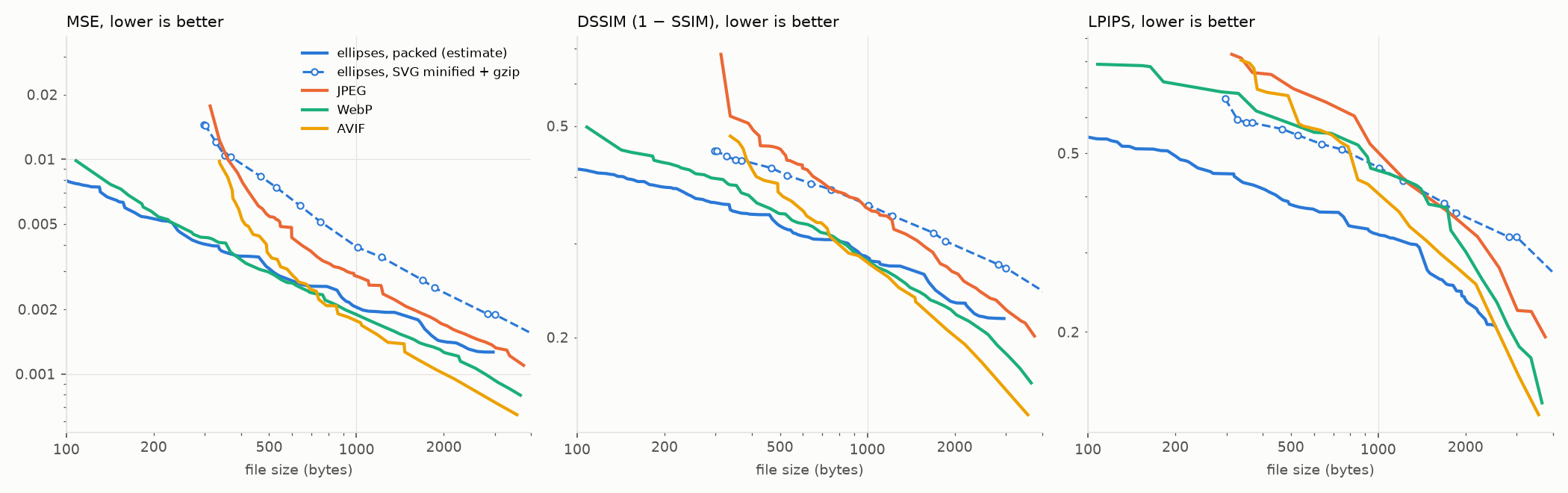
As an art project, this doesn't need to be useful. But it did make me question whether this approach has any utility in compressing an image well. Obviously with the huge amount of compute necessary to generate a single image, there's a slim use case for this, but if an image could be approximated well enough, is there a situation where this might be an interesting compression technique?
Well, probably still no, but it's still an interesting comparison. Our window for utility is around very small files, where a few chosen ellipses can approximate better than the noise needed in proper file formats. WebP is a very impressive compression format, and we struggle to get close. But perhaps looking at the images you might like the more 'abstract impressionism' of the compression over the blocky noise.